
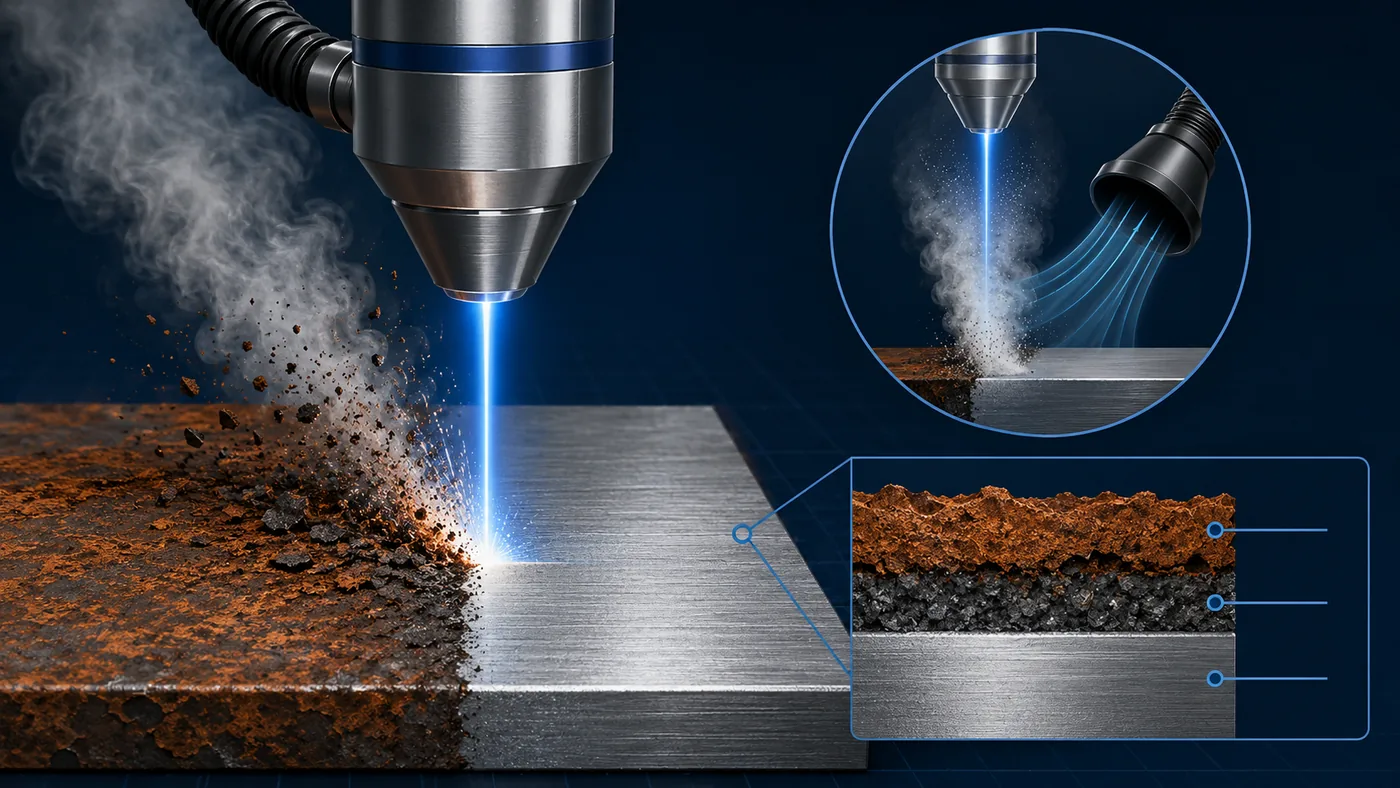
The principle
How does it work?
The beam scans the surface using parameters matched to the layer being removed. Particles and fumes are captured close to the work area by suitable extraction.
Industrial application
What the buyer should clarify
A suitable technology must match the parts, volumes, production environment, and resources available on site.
Typical uses
Removing rust, paint, oxides, and contaminants; preparation before welding or bonding; cleaning molds.
Typical materials
Metals and substrates where the unwanted layer absorbs energy differently from the base material.
Typical industries
Maintenance, metal fabrication, automotive, molds and tooling, agricultural equipment, and restoration.
Before buying
Points to check
- Type and thickness of the layer
- Substrate sensitivity
- Total area and throughput
- Required surface condition
- Particle and fume extraction
- Laser safety and work area
- Automation, maintenance, and trials
Choose with perspective
When laser may not be the best option
Blasting, brushing, or chemical methods may be faster or less expensive on very large simple surfaces where selectivity and waste reduction do not create enough value.
Industrial benefits
The main advantages
The value of the process is measured through achieved quality, production time, and the operations it can remove or simplify.
Selectivity
Only the required area can be treated instead of the entire part.
Dry process
No abrasive media, chemical bath, or rinsing.
Low waste
The quantity of residue is generally limited.
Repeatability
Parameters and scan paths can be automated.
Trials are needed to remove the layer without discoloring, overheating, or damaging the substrate.