
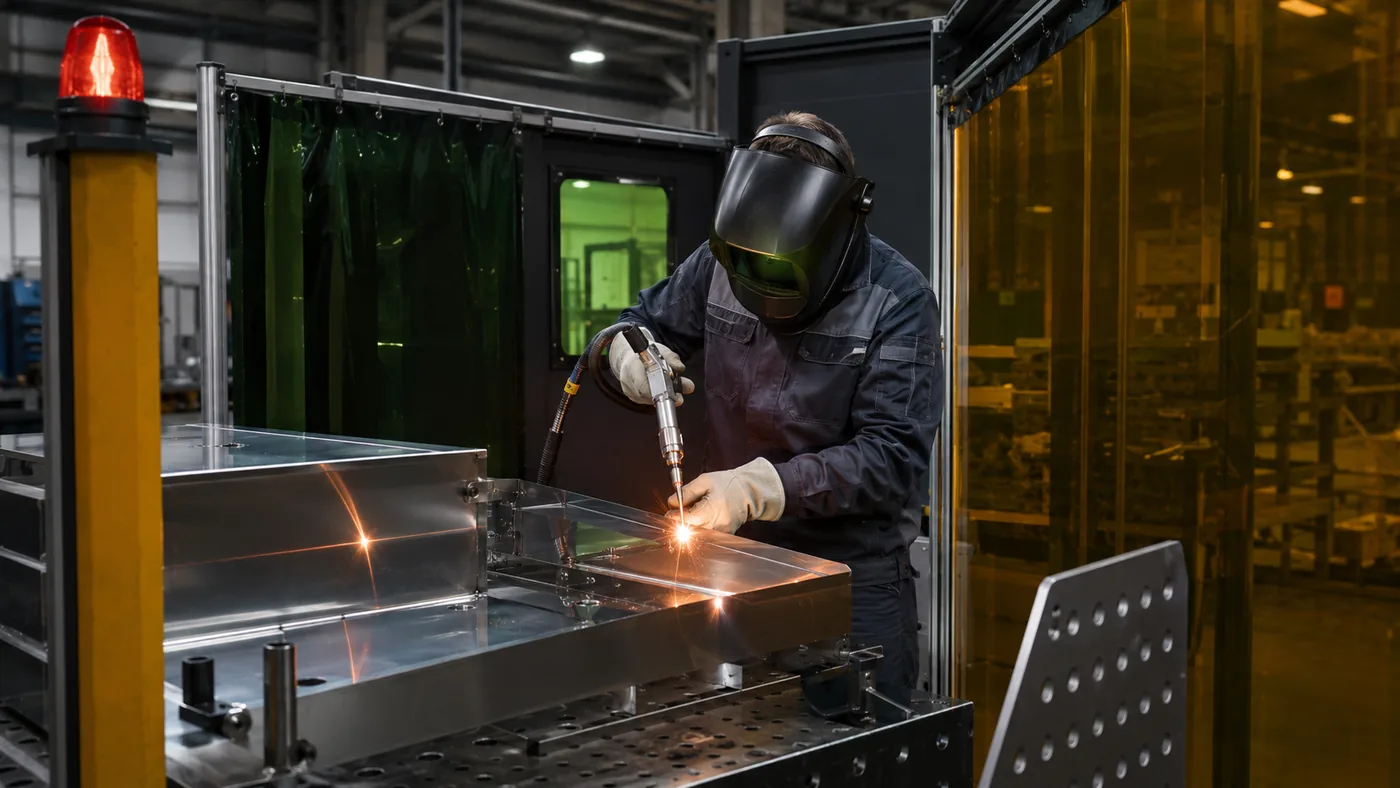
The principle
How does it work?
The source sends the beam to a handheld or automated head. The optics focus it on the joint, while shielding gas limits oxidation. Filler wire can be added where required.
Industrial application
What the buyer should clarify
A suitable technology must match the parts, volumes, production environment, and resources available on site.
Typical uses
Joining sheet metal, enclosures, housings, vessels, piping, and subassemblies manually or automatically.
Typical materials
Steels, stainless steel, aluminium, and other alloys after validating weldability and joint preparation.
Typical industries
Sheet-metal fabrication, industrial equipment, automotive, metal products, and precision devices.
Before buying
Points to check
- Material, thickness, and joint design
- Fit-up gap and repeatability
- Seam quality, tightness, and appearance
- Filler wire and shielding-gas needs
- Laser safety and fume extraction
- Manual, robotic, or automated operation
- Training, maintenance, and spare parts
Choose with perspective
When laser may not be the best option
TIG or MIG/MAG often remain more appropriate for repair, variable gaps, difficult access, very short runs, or structures that do not justify laser-level preparation.
Industrial benefits
The main advantages
The value of the process is measured through achieved quality, production time, and the operations it can remove or simplify.
Speed
Cycle times can be shorter than TIG on suitable sheet-metal work.
Low distortion
Energy remains concentrated within a small area.
Clean seam
Less spatter, grinding, and polishing may be required.
Automation
The process can progress from a manual station to a robotic cell.
Joint preparation, laser safety, and fume extraction are integral parts of the solution.