
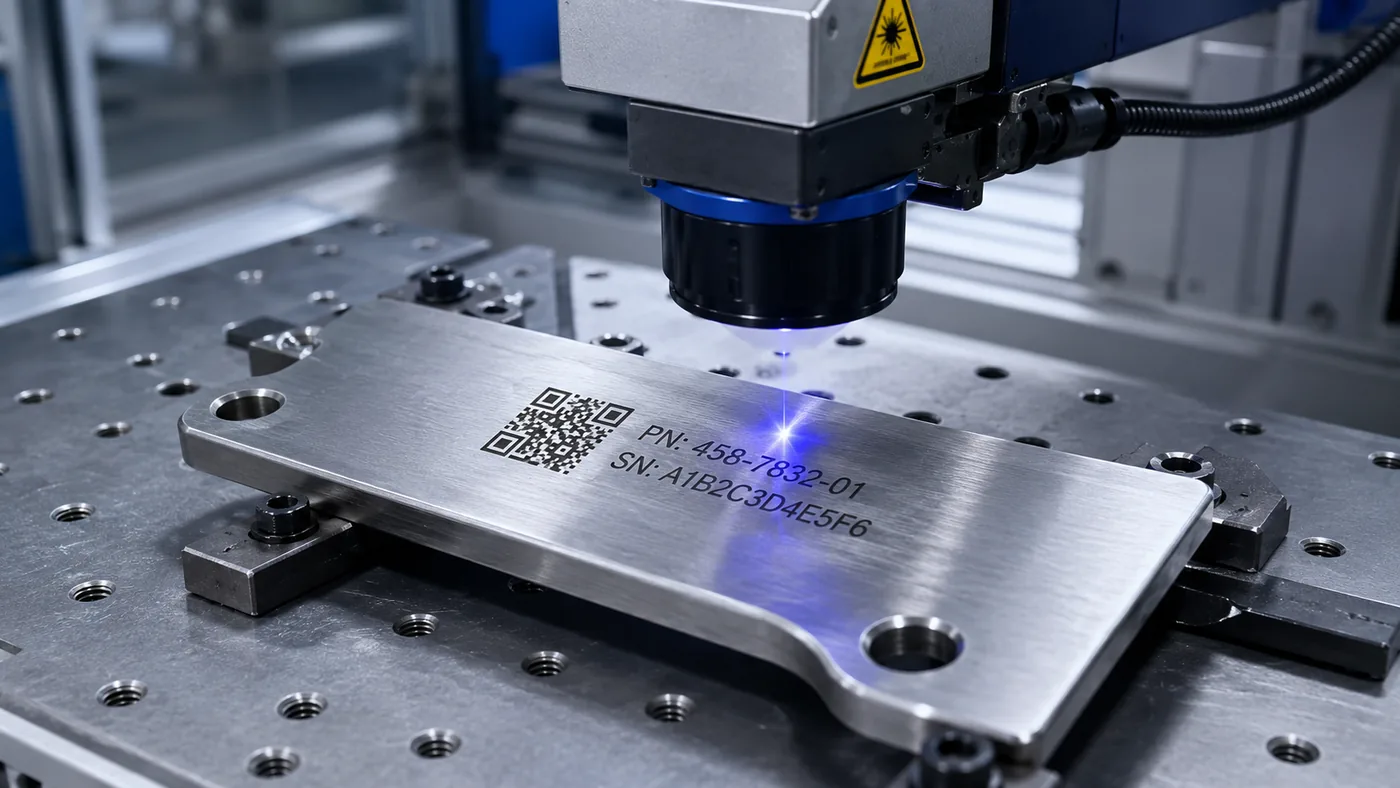
The principle
How does it work?
Fast mirrors or a CNC system move the laser spot according to a digital file. Power, speed, and frequency determine contrast, depth, and marking time.
Industrial application
What the buyer should clarify
A suitable technology must match the parts, volumes, production environment, and resources available on site.
Typical uses
Serial numbers, logos, QR codes, Data Matrix codes, references, regulatory information, and traceability.
Typical materials
Metals, compatible plastics, anodized parts, and coated or painted surfaces depending on wavelength.
Typical industries
Automotive, electronics, medical devices, industrial equipment, and consumer products.
Before buying
Points to check
- Material and surface condition
- Contrast, depth, and durability
- Code size and reading speed
- Variable data and production-system connection
- Safety and extraction
- Marking cycle time
- Maintenance and trials on real parts
Choose with perspective
When laser may not be the best option
Labels, inkjet, or dot peen may be preferable when permanent marking is unnecessary, the surface is incompatible, or the part is too large to handle efficiently.
Industrial benefits
The main advantages
The value of the process is measured through achieved quality, production time, and the operations it can remove or simplify.
Permanent marking
Identification that resists handling and wear.
High precision
Readable small characters, logos, QR codes, and Data Matrix codes.
No consumables
No ink, labels, or mechanical engraving-tool wear.
Traceability
Variable data can be connected to production records.
Engraving generally removes material, while marking may only change the color or condition of the surface.